I’ve found that one of the most difficult tasks of writing a book is deciding what to put on the cover. My mind isn’t particularly artsy. I want to put a title in black letters on a white background and call it a day. My wife reminds me that my ideas for book covers always look like textbooks. Nobody likes or wants to buy textbooks.
In a flash of brilliance, I realized that my wife is an artist and, for me, she works for free. But even with her help, it’s hard to capture the essence of a book in a single picture. Indeed, you cannot judge a book by its cover.
You can’t judge people by simply looking at the outside either.
Many people we meet aren’t always what they appear to be. The guy you pass in Walmart wearing camo sweatpants and Crocs may (emphasis on may) be a genius. The loud, laughing guy in the crowd may be carrying a world of hurt. Mr. Calm may be on the verge of becoming Mr. Snap. The young girl everyone thinks is beautiful may hate herself because she doesn’t feel pretty.
Sometimes people take on another identity, an alter ego, that reveals a different side of who they are. Samuel Langhorne Clemens did that when he became Mark Twain. As for me, if I ever decide to create an alter ego, I might go by the name “Pastor Portly” or “The Sweaty Theologian.”
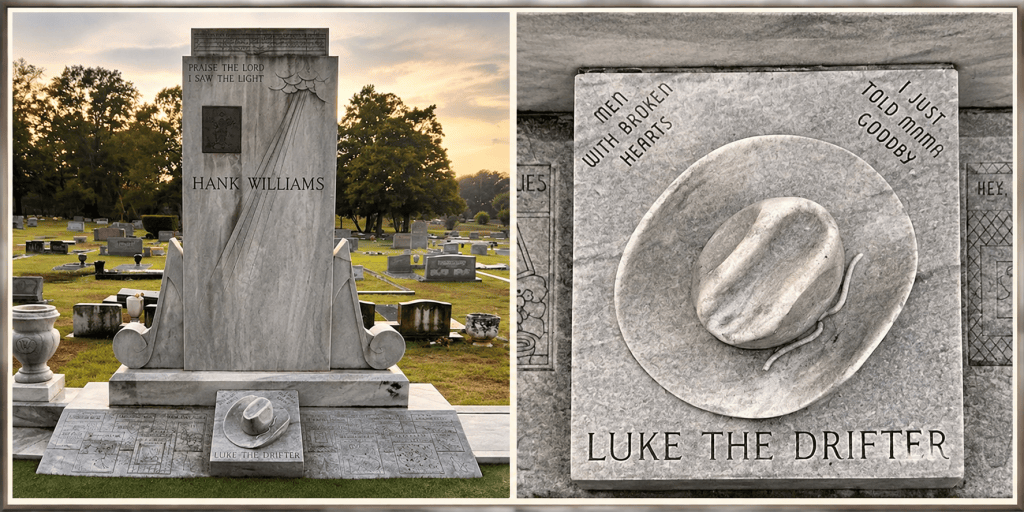
One of the most fascinating examples of an alter ego was that of Hank Williams Sr. Williams’ career was like a huge, bright, exploding sky on the Fourth of July. His first commercial record was released in January 1947, when he was just 23 years old. His short career ended when he died at the age of 29 on New Year’s Day 1953. During that brief period, around 30 of his songs appeared on the country charts, and 11 reached number one, including records that became hits after his death. He sold millions of records during his lifetime. Since his death, thousands of recordings of his compositions have been made by other artists.
He lived life at full speed. He struggled with alcohol, personal troubles, and physical pain. He was the poster boy for “live hard, live fast, and make a beautiful corpse.” He burned out way too young.
But behind the public honky-tonk hero lived Luke the Drifter.
Hank took on the alter ego of Luke the Drifter for several reasons. Part of it was a business decision. On a Saturday night in a loud honky-tonk, a lot of people want to feed the jukebox and hear Hank Williams songs. A recitation of “The Funeral” might dampen the mood. Hank’s producer felt it might be better to release the gospel songs under another name.
But there may have been something more personal to it. The Luke the Drifter persona seems to have taken Hank back to a time when he wasn’t fighting so many demons. He was back at church as a child, surrounded by the old hymns of the faith.
One of the most interesting things about these two sides of Hank was that they seemed to talk to one another. Hank would sing about the wild life and broken hearts. Luke would sing about mercy, compassion, and forgiveness. Luke seemed to understand Hank’s struggles.
Luke was a different side of Hank. While people were feeding jukeboxes coins to hear “Your Cheatin’ Heart,” Luke was delivering stories and reflections about faith, human suffering, and the consequences of life’s choices. There was darkness and hope in the words of Luke the Drifter.
In the recording “Men with Broken Hearts,” you get a glimpse of the hurt Hank himself may have understood all too well. The last verse reads:
“Life sometimes can be so cruel that a heart will pray for death. God, why must these living dead know pain with every breath?”
I’m no poet, nor the son of a poet, but that’s good stuff. Dark stuff.
But alongside the darkness, there was hope. The story goes that while returning home from a trip with his mother, Hank was riding in the car when she noticed the lights of the airport. She told him they were getting close to home because she could see the lights. Those words reportedly stayed with Hank, and he turned that simple observation into one of his greatest songs, “I Saw the Light.”
The song speaks of wandering through life, chasing the things of the world, and finally recognizing the need for something greater. It is a song about coming home, not just to a place, but to God.
In one of Hank’s great Luke the Drifter recordings, “Help Me Understand,” he closes with a short prayer:
“Take me and lead me, and hold to my hand. Oh, Heavenly Father, help me understand.”
We’ve been there. Life comes at us. Hurt becomes a constant companion. Worry lies down with you every night and wakes up with you in the morning. Tomorrow is filled with anxiety because of some unexpected event. We don’t understand. We want answers. Somehow, we think if we had answers, things would be better.
Knowing doesn’t always make things better.
Christian faith isn’t believing only when we have all the answers. Faith doesn’t require all the details. Faith is trusting that God has all the answers, knows all the details, and is good. God is not surprised by the things that come our way. My friend and hero, an evangelist, used to say, “Did it ever occur to you that nothing ever occurred to God?” He knows your hurts and worries.
Pray, as Luke the Drifter sang, “Heavenly Father, help me understand.” But trust Him even when you don’t.
Signed,
Reverend Goodenough
Enjoyed the story? Subscribe to The Notebook and have new stories and devotions delivered straight to your inbox. I’d be glad to have you along.


Leave a Reply