“It takes two years to learn to speak and sixty to learn to keep quiet.” – Ernest Hemingway
Author: Scott Sullivan
-
Change

In 1964, Bob Dylan struck a nerve with his song, “The Times They Are a-Changin’.” There was upheaval and unrest in our nation. People were anxious and worried about the future. Many were concerned that the past, and the things they loved, were gone forever. Indeed, the times were a-changin’.
In our home, we could have this song playing in every room. The times are changing in our family. As I write this, my daughter will sleep in her room one more night before going off to college. There is concern about the future, and there is sadness because we recognize that the old way of life has changed forever.
Perhaps I’m a little different…no, I’m different. But while there is a tinge of sadness, excitement outweighs the feeling of loss. Her mother and I have been preparing her for this since the day our delivery doctor looked me in the eye and said, “You got your girl.” I think he muttered under his breath, “May God have mercy on your soul,” also.
As parents, we must understand that our children aren’t really ours. God has entrusted them to us. They are gifts that we are to care for and nurture.
Having said this, I don’t know many people who like change. I’m a routine person. I don’t like to have my routine altered, and when it happens, I tend to get a little grumpy. Shocking.
But change can be good. To want my daughter to always live at home would not be fair to her. It would keep her from becoming all that God planned for her to be.
During this season, I’ve been holding on to a promise that God made to Israel in Isaiah 43:19:
“Look, I am about to do something new; even now it is coming. Do you not see it?”
Yes, Lord, I can’t help but see it.
As one season comes to an end, another season begins. We struggle with new seasons because we can’t see what the future holds. It can be unsettling. We like to know what will happen…and when it will happen. We like to see the outcome from the beginning.
But that’s not the way God operates.
God tells us to trust Him with each step. He doesn’t give us a GPS readout of what the road looks like ahead and where each turn will take us. What is beautiful about this is that while we can’t see the road ahead of us, He can. He knows every danger and pitfall that lies ahead. He goes before us and walks with us.
The danger isn’t in the road ahead. The danger is when we fail to walk with Him as we travel the road.
Perhaps today, you are entering a new season. Today, you could write across the pages of your future the word change.
Pray. Hold tight to the One who goes ahead of you, loves you, and wants what is best for you. Keep your heart open to what God is doing as your life changes.
God is already in the season you are now entering.
Until the next page…
Scott Sullivan
The Notebook
-
What a Body Needs
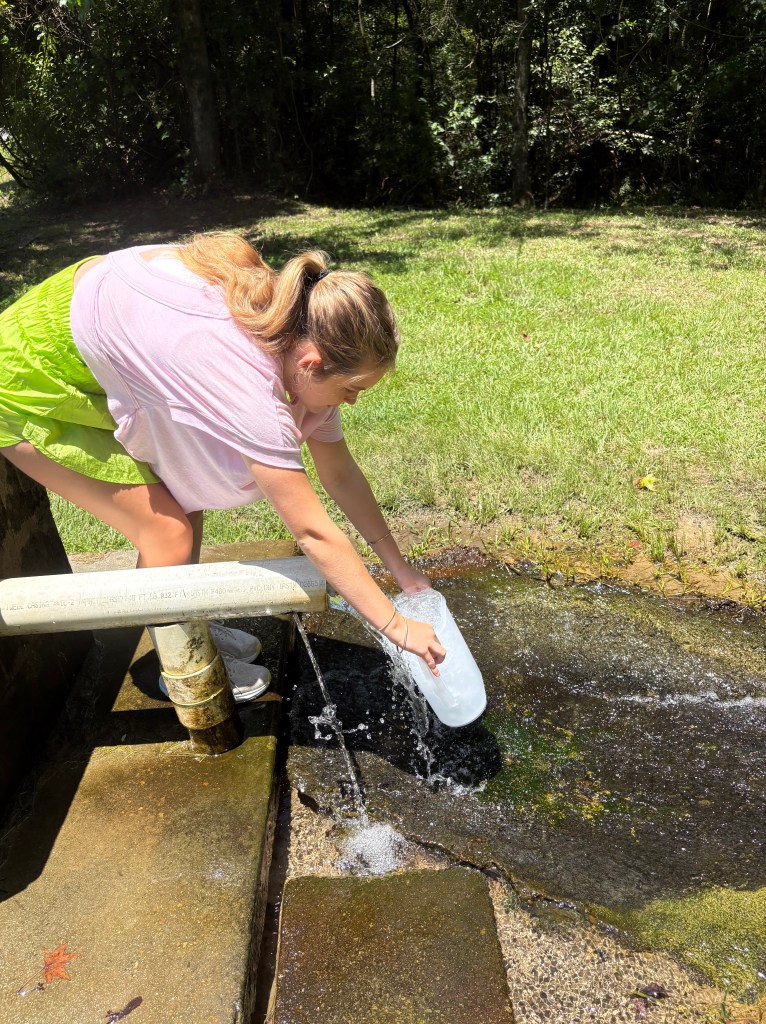
August in Mississippi. Just saying that makes me sweat. You know that kind of heat that makes the road look wet in the distance. There is nothing like stepping out the door in the morning and having summer give you a big, wet hug.
The thought of yard work in August makes my head itch. I know I’m getting older…look at me, and you know I’m getting older. But I used to be able to do my yard from start to finish. Now I cut a little…stop and drink some water. Weed eat a little…stop and drink some water. Walk to the front yard…stop and drink some water. My increased water intake stems from a phrase I’m using more and more: “I used to be able to…”
I don’t wear summer well. To a stranger, my body looks more like it’s leaking than sweating. And when I’m that hot, I don’t want a Coke. I don’t want a sports drink. I want water. Just cold water.
As a sign of my transition into the life of a curmudgeon, I’ve started taking old milk jugs and a plastic pitcher with me whenever I head north toward Lucedale. Why, you may ask? In the little community of Basin, there’s an artesian well. In the late 1930s, a drilling crew came through looking for oil. Instead of striking oil…they hit some of the best water that has ever crossed your lips. It tastes different from what comes out of my faucet, and unlike bottled water, it actually has a taste. I choose to believe it’s the minerals. God made minerals, by the way.
Why do our bodies crave water? Because we are mostly water. Our blood contains a great deal of it. But so do our brains, hearts, lungs, kidneys, muscles, and eyes. Most of them are made up of more than 70% water. No wonder I slosh sometimes.
God designed our bodies to crave water. Likewise, He created within each of us a craving for Him. We have a spiritual thirst. It cannot be satisfied with religious activity or good works. It can’t be satisfied with money, pleasure, relationships, or success. That thirst can only be satisfied by Jesus Christ.
In John 4, Jesus stops to speak with a woman at a well. She had tried to satisfy the cravings within her through relationships. She had been married five times and was living with a sixth man. She was empty. She was rejected. Jesus offered her the only thing that could truly satisfy…Himself…the Living Water.
Are you trying to satisfy your thirst for Jesus with other things today? Spit that buttermilk out and drink deep from the Living Water.
Until the next page…
Scott Sullivan
The Notebook
-
Let Me Tell You About a Friend of Mine
In the South, we have some customs that I hope never pass away. A lot of us send food rather than flowers when someone dies. Men walking with their wife or daughter still walk closest to the traffic. When addressing someone older than we are, we call them “Mr.” or “Mrs.” even when we’re all adults.
I’m not sure how it is in other parts of the country, and I really don’t want to find out, but in church there’s an unwritten seating chart. If a visitor sits in someone’s “seat,” the offended party would never say anything (I hope), but someone else might quietly whisper to the newcomer, “Come sit with me.”
Another Southern habit is waving for the other driver to go first at a four-way stop. The problem comes when they’re waving you on, too. Eventually, somebody has to be rude and just go.
But one of my favorite customs is pulling over to the side of the road as a funeral procession passes. It’s a quiet way of showing respect for the dead and compassion for those who grieve. Not only do you pull over, but you don’t dare pass the procession. Not only will you get some ugly looks from the grieving family, but there is a good chance you will make a new friend who happens to be wearing a badge.
This past Saturday, I found myself riding in a funeral procession. Most of the people traveling that highway pulled over. A few paid no attention to the procession or to the line of cars gathered along the shoulder. Their mothers must not have let them lick the spoon growing up.
The truth is, they didn’t pull over because they didn’t know my friend, Gary Holland. Had they known Gary, they would have pulled over and gotten in line with the rest of us.
Gary took a chance on me and hired me to work at Fred’s Dollar Store while I was still in junior high. My dad had to sign a waiver because I wasn’t old enough to work. For the next nine years, from junior high through college, I was a Fred’s employee. Though I was a year short, when I left Fred’s Gary gave me a ten-year service pin.
Think about that. There are people who spend their entire careers moving from job to job and never stay anywhere more than a couple of years. At twenty-two years old, I had a ten-year pin.
Working for Gary was an education.
I learned a lot of Jimmy Buffett songs. I was introduced to Rush Limbaugh. I learned a little about restoring old cars. I learned what moonwalking almost looked like. The keyword is almost. I learned how to treat employees. Believe it or not, I even learned a little chemistry.
One night Gary and I decided that instead of hiring the usual crew to strip and wax the floors, we’d do it ourselves. We rented a buffer and looked around the store, convinced we already had all the cleaning supplies we needed.
What we didn’t know was that some chemicals should never be mixed.
Clorox bleach and ammonia may seem like they would make a great floor cleaner, but together they produce toxic gas. Johnson & Johnson wouldn’t have approved, but the Kaiser might have.
I also learned the danger of using the almost right word.
My primary job at Fred’s was unloading trucks and stocking shelves. One day we received a call from the home office explaining that the truck would be delayed. Gary happened to be in the restroom, so one of my fellow truck unloaders answered the phone.
When the caller asked to speak with Gary, my coworker confidently replied, “He’s decomposed.”
I quickly explained that the word he was looking for was indisposed.
Close…but no cigar.
There were also lessons in pest control that you won’t find in a Terminix brochure…but that’s a story for another day.
Over the years, my relationship with Gary changed from boss and employee to lifelong friends. If Gary Holland was your friend, he was your friend for life.
In the thirty-six years since I left Fred’s, almost every month Gary either called me or stopped by my office. We’d laugh. Catch up on life. Talk about his battle with Parkinson’s. Solve most of the world’s problems.
When our visit ended, Gary always said, “I love you.”
And I believe he meant it.
Following Gary’s funeral procession, all those memories came flooding back. Yet my thoughts weren’t centered on what he taught me at Fred’s or even on the conversations we’d shared over the years. I found myself thinking about the way he lived.
Gary battled Parkinson’s for years, yet he never stopped making much of Jesus.
Sometimes God moves mountains and changes our circumstances.
Sometimes He doesn’t.
Gary taught me that faith isn’t measured by whether the storm goes away. It’s measured by whether we continue trusting the One who walks with us through it. God didn’t remove every hardship from Gary’s life, but He never left his side.
Gary wore many titles: husband, father, grandfather, son, brother.
But to me, he was my Jesus-loving friend.
Had the people driving down that highway known him like I did…
they would have pulled over.
Until the next page…
Scott Sullivan
The Notebook

-
The Author
As someone who loves to write, it always excites me when someone picks up one of my books. But what means even more is when they come back later and say, “I’ve enjoyed reading your book. It has meant a lot to me.”
There is no greater compliment an author can receive than knowing someone has actually read what they wrote and that it made a difference.
That thought came to me recently while reading the book of Acts. In Acts 3:15, Peter boldly tells the crowd, “You killed the source of life, whom God raised from the dead; we are witnesses of this” (CSB). Other translations describe Jesus as the Author of life.
Peter was speaking to the very people who had rejected Christ.
They killed the Author.
Almost every time I write a devotion or work on a book, there is a rewrite process. What I intended to say doesn’t always make it onto the page the first time. Sometimes a sentence needs to be clearer. Sometimes one word carries far more weight than another. Mark Twain famously said that the difference between the right word and the almost right word is the difference between lightning and the lightning bug. Every good writer knows that editing is where much of the real work happens.
Now imagine an author who dies before finishing his work. There are no more stories to tell. No more chapters to write. No more words of wisdom, instruction, or encouragement.
They killed the Author.
For three days, it appeared the story was over.
But Acts 3:15 doesn’t end with death. Peter immediately declares that God raised Him from the dead.
The Author lives.
Jesus Christ, the Author of life, is still writing. He is still creating. He is still transforming lives. He can rewrite the broken chapters of your past. He can begin a new work in your heart. He can change the ending of your story. He still speaks words of truth, hope, encouragement, and grace to all who will listen.
They killed the Author…
…but God raised Him from the dead.
And because the Author lives, your story is not finished.
Until the next page…
Scott Sullivan
The Notebook

-
One Sinner
Luke 15:10 — 10 I tell you, in the same way, there is joy in the presence of God’s angels over one sinner who repents.”
Luke chapter 15 is often called the chapter of lost things. Jesus tells three parables: a lost sheep, a lost coin, and a lost son. Amazingly, the One who created all things is deeply concerned about what is lost. The psalmist reminds us, “For every animal of the forest is Mine, the cattle on a thousand hills” (Psalm 50:10). Since God owns everything, it would seem that when something is lost, He could simply replace it. He certainly could. But He doesn’t.
Have you ever stopped to consider that when a person wanders from God or rejects Him, God doesn’t simply write them off? He does just the opposite. God sent His Son to seek and save what was lost…you and me.
He didn’t do this because He was competing with Satan or trying to improve His numbers. In fact, Jesus said the road that leads to life is narrow, and few find it. God didn’t send His Son to win a competition. He sent His Son because He loves us.
When I think about that exchange…God giving His Son for sinful humanity…my mind goes to the hymn, How Deep the Father’s Love for Us:
“How deep the Father’s love for us,
How vast beyond all measure,
That He should give His only Son,
To make a wretch His treasure.“
Question: If God cared enough to send His Son to die for the lost…do we care enough to even share the Gospel with those we encounter? In the words of the late Pastor Voddie Baucham, “If you can’t say amen, say ouch.”
Until the next page…
Scott Sullivan
The Notebook
-
Talking Turkey
There is much debate about what warrants a position on the Thanksgiving table. I have a highly unpopular view in my family that if all the dishes we prepared at Thanksgiving were really that good, we would eat them throughout the year. I’ve never been sitting in my office thinking, “Boy, I hope Angela has made a green bean casserole for supper.” Green bean casserole is one of those things you tolerate (notice I didn’t say like) or you don’t. Thanksgiving dishes can split otherwise decent people into hardened factions. Cranberry sauce either consists of fresh cranberries cooked down in a mound of sugar, water, and a touch of orange juice, or it comes in a can and makes a sucking noise as it flops out. There is a whole generation of people who were raised believing that cranberry sauce came with ridges. Pick your side, but do so carefully because whatever you choose will be served from now until your last Thanksgiving. Dressing is also up for debate. Does it have stuff in it…like oysters, for instance? Does it have sage in it? Does it have ground sausage in it? These are all things that need to be discussed with your preacher prior to your wedding.
The one thing that seems to cause less debate is turkey. Now I’ve heard some heathens don’t do turkey at Thanksgiving. Turkey is passed over for substitutes. Never trust a man who eats lasagna on Thanksgiving. That’s the kind of behavior that makes old church ladies whisper during the invitation hymn. Some people are intimidated by the process of cooking a turkey and will say that it’s too much trouble. That’s the kind of laziness that should cause concern for the future of our nation. Now I’m not saying that you have to cook a turkey on Thanksgiving. You don’t have to wear shoes to a funeral either. Just know that neglecting either will cause people to talk.
When I was a kid, my mother and later my brother were in charge of cooking the turkey. My job was to sit and watch the little red thing pop up when it was done. I took this job seriously and probably added to the cooking time by constantly opening the door to check and see if we had a pop-up yet. To me, it ranked right up there with watching the TV and seeing the ball fall on New Year’s Eve.
I also remember a Thanksgiving where, after resting a moment after eating, my brother Bob decided it was as good a time as any to make a new door between rooms. Saws came out, and construction commenced. Most families watch football on Thanksgiving. We altered load-bearing walls. That’s probably better left to another story.
Somehow, as an adult, I have assumed the role of chief turkey cook in our home. I’m not sure exactly how this happened. But I do remember vividly the first turkey I cooked for Thanksgiving. Like my family growing up, Thanksgiving was big in Angela’s family as well. On the occasion of my first turkey cooking, we gathered at her grandmother’s house, Mrs. Sybil. Just a heads up here, when you want someone to cook something they have never cooked before, you might want to not have them do it on Thanksgiving, with the centerpiece of the meal.
Mrs. Sybil was a special lady. When I came to know her, she was older and bent over from age. But I remember that at her house, she was always humming or singing hymns under her breath. And she always bobbed her foot up and down to keep time with the song that only she could hear. She was the first person I told of my intentions to ask Angela to marry me. She was so happy. Partly because her granddaughter was getting married, but also because she knew something that no one else knew yet.
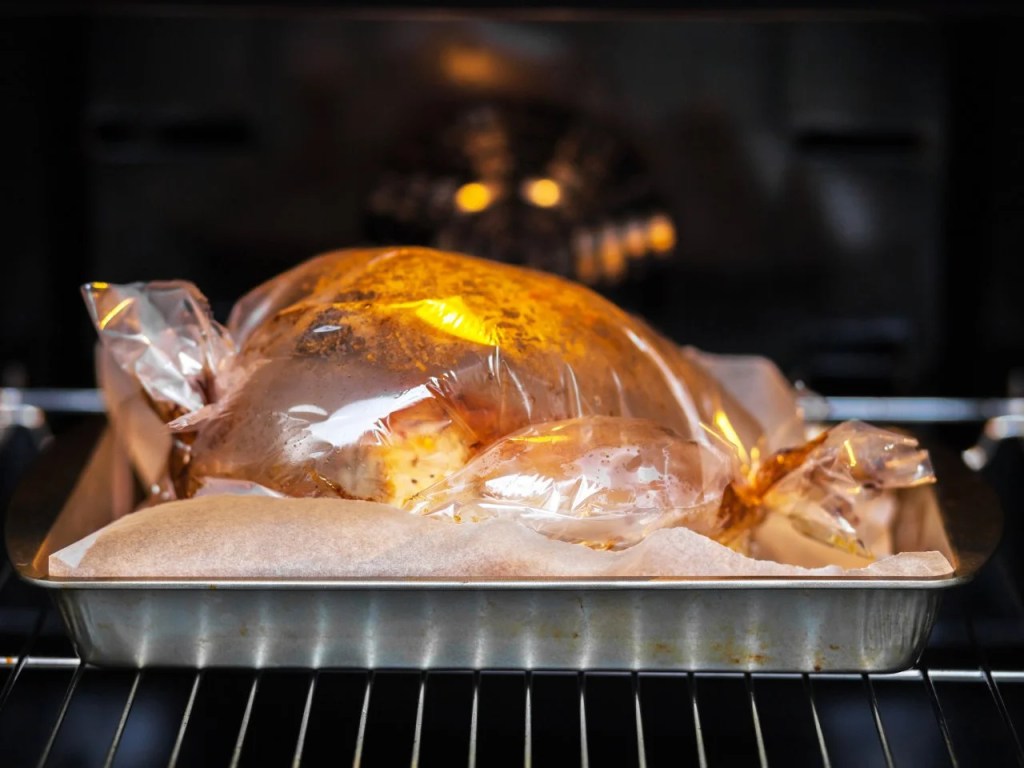
On that first Thanksgiving turkey test, I had done my homework. I had researched the art of turkey preparation. I assembled all the ingredients, picked out a sturdy pan, had my turkey roasting bag, and was ready to cook. I even had a turkey that had the little red pop-up timer. What could go wrong? Overconfidence is dangerous around a hot stove and family. I removed the neck from the cavity and filled it with all the things I remember seeing in our turkeys growing up…butter, chunks of onion, oranges, garlic, and spices. I also had a pot on the stove with orange juice, butter, and spices that I used to baste the turkey every 30 minutes.
When the popper popped…it looked good. It smelled good. I was pleased. As I was beginning to take it from the pan to a platter, Mrs. Sybil quietly pointed out something that saved me. On the other end of the turkey, the…well, you know…was a little white bag of something. I didn’t know about this bag. When I pulled the neck out of the cavity, I assumed that was all the “parts.” I didn’t know that the modern-day turkey was prepped like an Egyptian mummy. Apparently, Butterball believes a turkey ought to enter eternity with all its belongings. There isn’t a more embarrassing thing to do than to take a set of tongs and extract a hot bag of turkey organs before serving your family.
That Thanksgiving taught me a couple of lessons. There was a practical lesson I learned: always look at both ends of the turkey before beginning the cooking process. There was also a lesson buried in my faux pas. I learned that the event was more important than the actual food itself. Most people can’t remember a single Thanksgiving menu from ten years ago, but they can remember who sat at the table. I remember those Thanksgivings with my family and now Angela’s family, but I really don’t remember any special dish. I remember watching for the timer to pop up. I remember tearing out a wall, just cause. I remember the look on Angela’s grandmother’s face when she saw the edges of that little white bag sticking out of a freshly cooked turkey. Thanksgiving, even if you eat cranberry sauce that makes a sucking sound when it slides out of the can, is really about family, kids’ tables, stories, and remembering who’s missing from the table.
Until the next page…
Scott Sullivan
The Notebook
Editor’s Note: This story is adapted from my upcoming book, A Taste From My Past, a collection of stories about family, faith, laughter, tears, and food growing up here along the Mississippi Gulf Coast.
-
Take Your Fears to The Lord
Joshua 11:6 — 6 The Lord said to Joshua, “Do not be afraid of them, for at this time tomorrow I will cause all of them to be killed before Israel. You are to hamstring their horses and burn their chariots.”
In Joshua chapter 11, Israel faced one of its greatest military challenges. The enemy was overwhelming. Kings from Hazor, Madon, Shimron, Achshaph, the hill country, and the lowlands joined forces against God’s people. The Canaanites, Amorites, Hittites, Perizzites, Jebusites, and Hivites all gathered for battle. As if that weren’t enough, they possessed countless horses and chariots, giving them a military advantage Israel simply didn’t have. Humanly speaking, Israel had every reason to be afraid.
God’s words reveal what Joshua was likely feeling. The Lord said to Joshua, “Don’t be afraid.” You don’t tell someone not to be afraid unless fear is knocking at the door. From a human perspective, Joshua had every reason to be intimidated. His enemies were numerous, well-equipped, and prepared for battle. Most of us would have felt exactly the same way.
Today, our enemies may look different, but they are no less real. We face frightening diagnoses, uncertain futures, financial pressures, broken relationships, and countless other fears. They may seem distant when they belong to someone else, but they become very personal when they arrive at our own doorstep.
The God who strengthened Joshua has not changed. He still knows our fears before we speak them. He still walks with His people. He still keeps His promises. Whatever fear has found its way to your doorstep today, take it to the Lord. You may not know what tomorrow holds, but you can trust the One who does.
Until the next page…
Scott Sullivan
The Notebook
Editor’s Note: This devotion is adapted from my book Reflecting on the Word, a collection of 52 weekly devotions centered on Scripture and practical application. If it encouraged you, you’ll find many more like it in the book.
-
Just Slow Down
Why are we in such a hurry? Tomorrow isn’t going anywhere. We risk getting a speeding ticket just to arrive five minutes sooner. If our schedule is so tight that we can’t spare five extra minutes, perhaps we’ve made some poor decisions about what deserves our time.
There is a fine line between taking it easy…and loafing…I lean toward the loaf. I was not bred to be a race car. I’m more like an old, beat-up truck that runs best in third gear. If you push it too hard, something might break. I’m not taking any chances. This fine piece of machinery wasn’t built for racing.
We rush our meals. The chicken’s dead…it isn’t going anywhere…take your time. Some people eat with such speed that it makes you wonder if they have warrants out. Slow down! Do you know that if you slow down when you eat, some of those things on your plate actually have a taste?
I’m coming full circle with reading. As a first grader, I slowly learned to read. When I read aloud, I spoke slowly. Somewhere along the way, we started believing that reading faster meant we were smarter. Over the last few years, I’ve been consciously trying to read more slowly. It’s amazing what it has done for my retention.
I’m going back and reading all of William Faulkner’s books…you have to read them slowly. It’s funny, and I’m sure I’m not the only one, but whoever I’m reading…I hear the author’s voice in my head. Reading As I Lay Dying, I hear Faulkner in my head…and when I stop reading, I have to turn him off before I start talking to people in the voice of a Confederate general.
We read the Bible too fast. Again…what’s the rush? It’s the greatest book ever written…enjoy it. Let it sink in.
As a pastor, people will sometimes ask me, “How much of the Bible should I read each day?” My standard answer is, “Read until God stops you.” Read with an attitude of expectation…desiring to hear from God. And when He speaks…stop and let it sink in.
You cannot do that by speed-reading the Bible.
Each year I set Bible reading goals. Some years I read through the entire Bible. Some years I focus only on the New Testament. Regardless of how much you read…make sure you are reading slowly enough for God’s Word to settle into your heart and mind.
Psalm 46:10 reads, “Be still and know that I am God.”
Sometimes the most spiritual thing we can do isn’t speed up. It’s to slow down long enough to notice that God has been there all along.
Until the next page…
Scott Sullivan
The Notebook
 Scott Sullivan